

The philosopher Slavoj Žižek once made the provocative claim about love: “If you can explain why you love a person, then you don’t truly love them.” Love cannot be logically argued. Unlike science, logic, or mathematics, it is irrational and ultimately inexplicable.
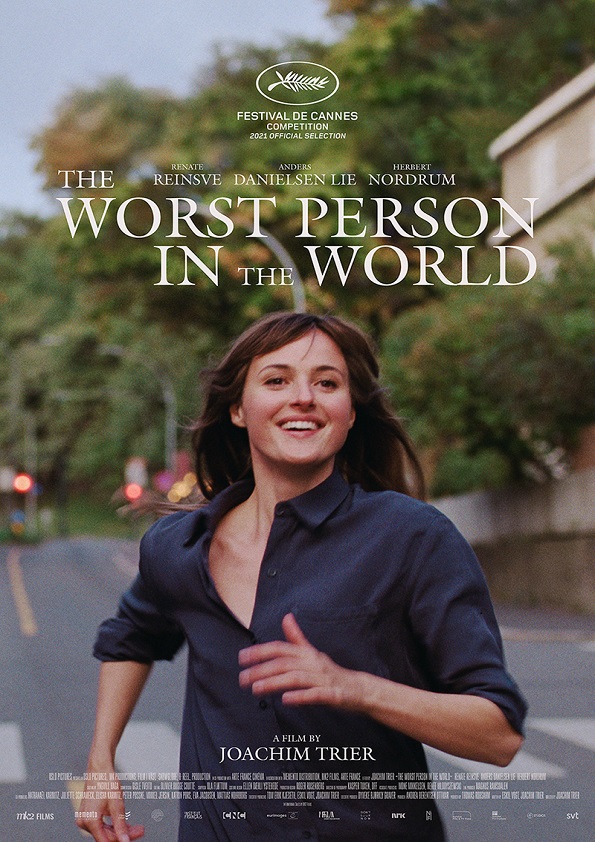
This idea is reflected in the actions of the main characters in Joachim Trier’s The Worst Person in the World. Characters fall in love with one another despite obvious conflicts and tensions between them. These tensions eventually lead them to fall out of love—only for them to realize later that the affection they once felt never truly disappeared, but merely began to express itself in a different way.
On the surface, Julie may appear to embody what the title suggests: “the worst person in the world.” Yet if one approaches the film through Žižek’s perspective—allowing oneself to be overwhelmed by the irrationality of feeling—one can ultimately only conclude that the protagonist is certainly not the worst person. She is simply a person.
At the beginning of the film, a voice-over suggests that the protagonist Julie’s passion is “her soul.” She acts quickly, often radically. She abandons one career in order to pursue a new goal. She experiments, and she lets go of whatever holds her back.
Her soul guides her through her entire life, including her relationships. She first falls in love with a much older graphic novel writer, Aksel, who even warns her about the difficulties their relationship might bring. And yet: “This was the time when she decided to fall in love with him.” She runs back up the stairs to his apartment and makes the choice to be with him.
Once they are in a relationship, however, cracks quickly begin to form. At a party, Aksel asks her about the possibility of having children. She responds firmly that she does not have what it takes to be a mother. In his view, however, this is simply “how relationships work.”
Julie seems trapped in a world she does not want to inhabit. This is best symbolized through a wide shot at the party: the camera is placed outside the tiny house, and the audience looks in from the vast, open landscape into the cramped interior. Her life begins to narrow, pushed into responsibilities she does not want. She is forced into a box, into becoming the person her partner wants her to be.
Eventually, she literally “leaves” her identity behind. She attends a party under a different name. Her “real” identity has become a symbol of imprisonment. Paradoxically, she puts on a mask in order to be herself.
At the party she meets a man named Eivind. She admits to him that she hates answering casual questions—it is “a mask of politeness.” He agrees. Both confess that they hate pretending to be someone they are not.
They retreat to a quiet place in the house, but they do not sleep together. Instead, they listen to each other while urinating. This intimacy stands in contrast to Aksel’s more conservative world.
At this point in the narrative, it may seem as though Julie has fallen out of love with Aksel and fallen in love with Eivind. She struggles with her partner’s values after encountering someone who does not embody them. But things become complicated.
By the end of the film, tragic circumstances bring Julie and Aksel together again. He reflects on his life, particularly his relationship to culture. He remembers that when he was younger, culture was transmitted through objects—material things one could hold in one’s hands.
He had difficulty seeing culture as anything other than materialism: objects to possess and collect. He applied this mindset to his relationship with Julie as well. He wanted physical expressions of their relationship, as if hanging a movie poster on the wall. Such physical expressions might include concepts like marriage and children.
The problem he faced, however—returning to Žižek—is that feeling is irrational and inexplicable. Love is not tangible like an object. Love cannot be expressed through materialism.
His failure to understand this ultimately led to the erosion of their relationship.
Julie is guided by the willingness of her soul, and she chooses to embrace the pure feelings it communicates to her. She falls in love irrationally; its roots cannot be explained or traced back to an origin.
Love is invigorating, but in the case of the film’s characters, it is also confusing and frustrating. The feelings all three developed for one another were real—whether through offering emotional and creative support, or through allowing one another vulnerability.
Characters fall in love and fall out of love, changing physically and emotionally over the course of the story. Yet the feelings they held for each other never truly disappeared. What changed was the way those feelings were expressed.
Love is not negative. It is simply irrational and cannot properly be expressed through materialism. Rather, it is a selfless act in which one individual surrenders themselves to another’s trust.
And that is what makes—or breaks—a person.
The Worst Person in the World:
The Irrationality of Love
19/12/2022