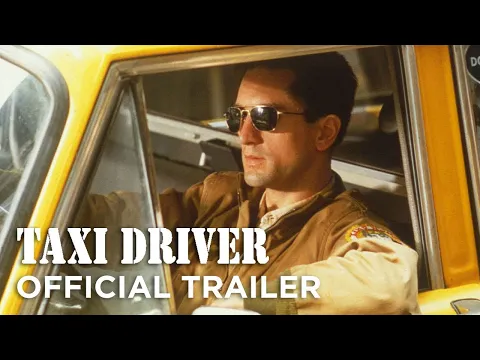


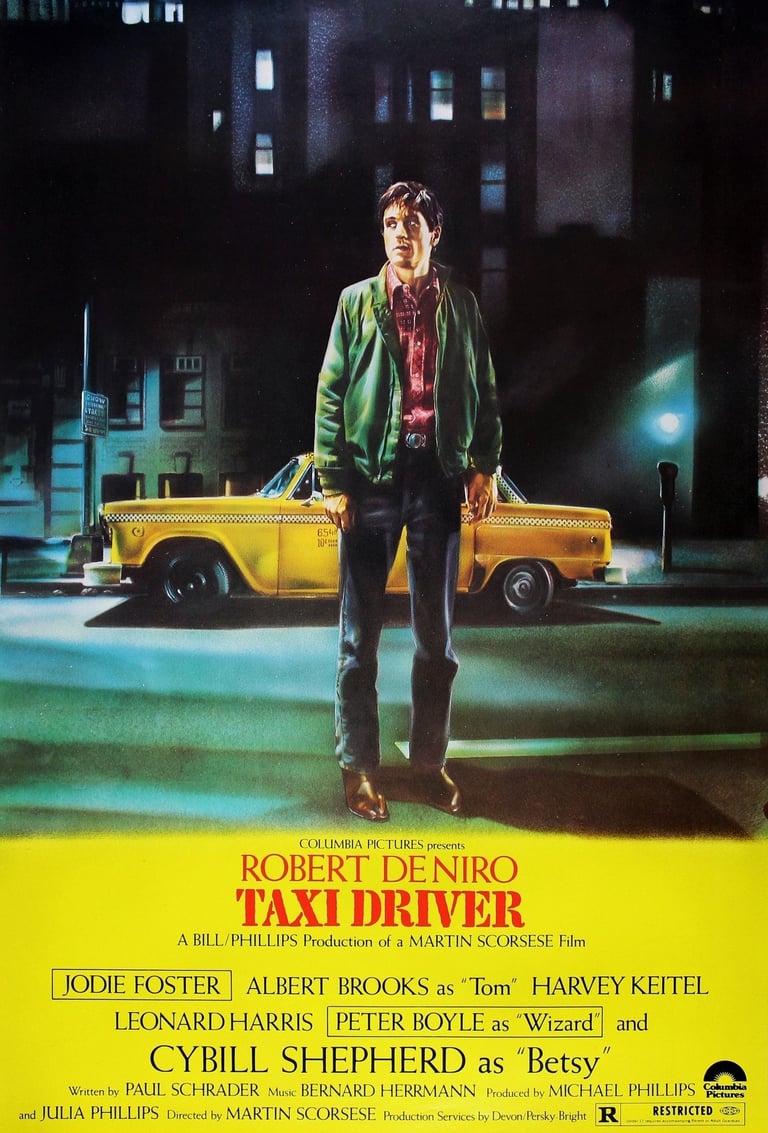
I remember vividly how Martin Scorsese’s Taxi Driver impacted me and my best friend from high school. We found the character of Travis Bickle shocking, and in a strange way even prophetic. A man who would rant about the rot and dirt that he exposes himself to in New York, working as a taxi driver. But he is also a man who engages with that same rotten behaviour he complains about. This always made us question: just how genuine Travis is. Indeed, we both ended up agreeing with Betsy’s assessment: that he’s a man of contradiction. Travis doesn’t seek to solve problems, but pathetically expose himself to them, because they fuel his hatred. Perhaps this is the reason why he seemed prophetic, as we recognised the parallels of Travis’ personality within the strengthening ‘alt-right’ movement at the time. A personality which doesn’t seek to solve problems with ideals or compassion, but rather simply exposing themselves to the injustice as a tool to fuel their personality of hatred.
What makes Travis compelling is that he is in fact an impoverished, worn-down man. He says he can’t sleep at night which is why he wants to work as a taxi driver. He is seen leaving the depot in a wide shot as he drinks alcohol. This gives us a good understanding about the state of the city, the state of Travis’ life, yes, it is rundown, yes, it is left behind. Travis is miniscule and worthless, a nobody in the seemingly endless streets of this nightmarish city. The behaviour he encounters as a taxi driver is reprehensible: pimps pulling their underage prostitutes out of the cab, or yuppie passengers expressing their horrendous murder fantasies to Travis. What is significant about this is that the rot is reality, it is not an invention of Travis’ twisted mind. What is also significant is Travis’ reaction. In the aforementioned scene when he drives the yuppie, he is framed in a close-up attentively listening, it is unclear what he thinks.
His eyes are ripped wide-open, and the audience has no idea what he thinks, does he agree with the yuppie? Does he despise the yuppie? What is clear though is that Travis cannot look away. One of the earliest shots in the film is an extreme-close-up of his eyes as they seem to look through the windscreen. Red beams are projected against his eyes, symbolising his hatred. The hatred fuels him, he seems to be addicted to the crime of the city. Indeed, whenever he engages with other people or to the audience through voice-over, he can never not emphasise his hatred about the city. What will he do to actually solve the problems? It is never clear what he would pursue to solve the problems, what is clear though is that ranting about the city defines his personality, it is him. He rants at Palantine that this city has to be ‘flushed down the toilet’. His genuine opinion on injustice doesn’t matter, it’s all about feeding his hatred.
Travis’ problematic behaviour is even emphasised with the introduction of Betsy. In particular in her introduction scene, the contrast is bright, and the scene moves in slow-motion, exaggerating the beauty of the moment. Travis seems to acknowledge that not everything is morally repugnant and dirty in New York, there is hope and love. But Travis seems to alienate her almost immediately upon taking her out on a date, as they visit an adult cinema. Once she leaves in horror, he struggles to understand why she’s angry. Instead of reflecting on his actions, he rants to the audience, condemning her as no different from the rest of this disgusting city. He pushes ‘beauty’ away, almost deliberately in order to continue his game of playing the helpless victim in this helpless city. Although I don’t wish to justify Travis’ behaviour, his acting towards Betsy seems to make sense if he wants to keep his narrative alive. If the entire city is beyond saving, how can she be any different?
The truth about Betsy is the fact that she perhaps unintentionally exposes Travis as a man of contradictions. A man who stands for nothing other than using the injustice of the city to selfishly fuel his anger. This can be seen in the small details of how he lives his life: he claims to stop taking
pills and drinking alcohol, only to swallow a pill through a big sip of beer at the end of the film. What he sounds may sound nice, but in the end his words are nothing but empty paroles to justify a hateful personality. A man who would rather destroy and murder, rather than build and reform. Betsy, though campaigning for Palantine, acknowledges that they’re selling a candidate over a programme. She seems frustrated by this fact, as if she wanted something else, but unlike Travis she accepts this reality and works hard regardless. Travis is shaped by the system, but in the end, he is nothing special or profound.
Travis is exactly what Betsy prophesises him to be: a contradiction. Someone who radically attacks the supposed dirt in the city but does nothing to solve the underlying problems. In fact, he seems to be addicted to it, without it he doesn’t appear to have the ability to express himself. He is a radical without principles or solutions, which is why I perhaps saw in him a foreshadowing of the alt-right movement. A movement that preaches certain principles, but never to genuinely do something about it, rather instead they are addicted to it, like Travis to fuel their movement. Travis Bickle shows that principles and solutions to positions are necessary. Without them they can easily be coerced into empty platitudes which radicalise and incentivise violence. Yet it must also be important to analyse the worlds in which these shadows rise from, to prevent future Travis contradictions from rising. This slope is truly slippery, how can we solve the genuine issues, without giving Travis Bickle legitimacy.
Taxi Driver:
Contradiction as Prophecy
01/10/2024