

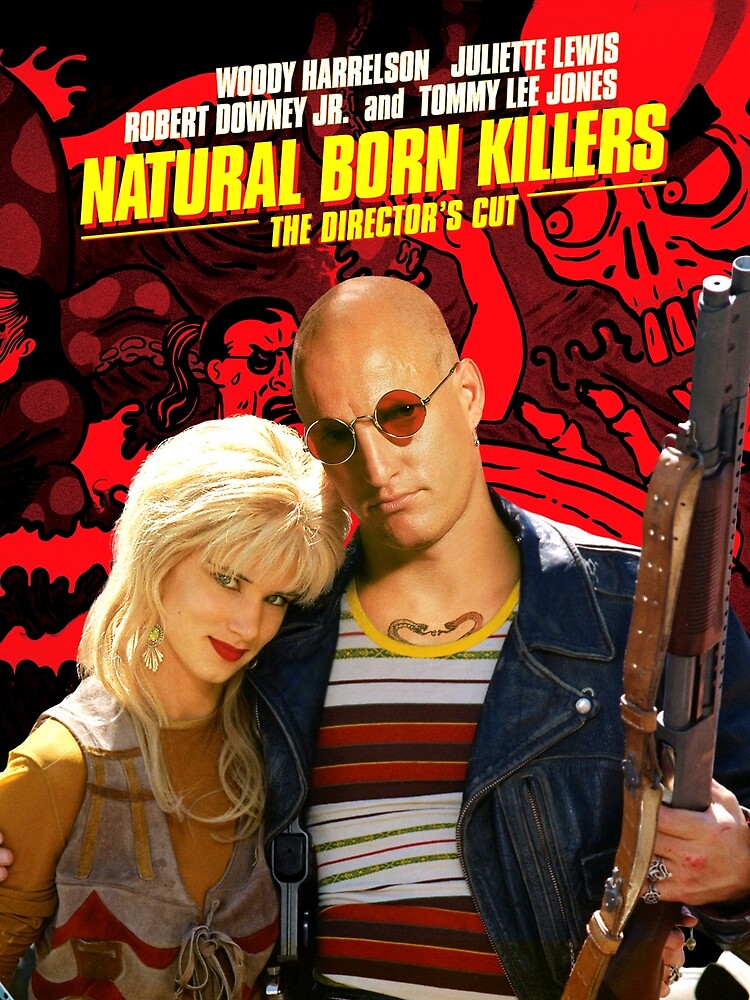
Oliver Stone’s Natural Born Killers sparked immediate controversy in the year of its release, primarily because of its excessive violence and its morally ambiguous protagonists, the murderous couple Mickey and Mallory Knox. Perhaps it was the violence, perhaps the ambiguity of its characters, that caused the film, compared to Stone’s other works (Platoon, Born on the Fourth of July, JFK, and Nixon), to fade somewhat into obscurity.
Yet upon revisiting it, one can recognize a culture of alarmism that remains relevant today. In an interview at the time of the film’s release, Stone criticized this culture in the United States. Politics and the media reinforce it by saturating the population with fear. This may even have been a premonition of the coming Bush administration.
However, such a culture of alarmism does not exist only in America. It also exists in other forms in states such as the Russian Federation, where it serves to solidify an autocratic system.
Like its characters, Natural Born Killers has an ambivalent style and experiments with different cinematic modes. The film uses black-and-white imagery alongside various color filters and even includes animated segments. These techniques are often employed to exaggerate the atmosphere of a scene.
This is especially clear in the opening, where Stone establishes an exaggerated tone of danger and lawlessness. A red filter is used in one shot, and the ominous lyrics of Leonard Cohen’s “Waiting for the Miracle” play over the opening credits. Lines such as “You wouldn’t like it here. There ain’t no entertainment, and the judgements are severe” intensify the heightened tone, accompanied by images of rattlesnakes.
What this reveals is simulation — a scene that feels clearly manipulated. This world is under the firm control of its director. The audience is not only given a tone for the narrative or the characters, but a tone for the world surrounding the film itself.
In that same opening scene, Mickey and Mallory commit a mass murder in a diner. The audience is soon confronted with the question of meaning: What motivates them?
The answer provided by the narrative is simple and without nuance. They live in a system they hate and want to destroy it, even if that means slaughtering innocent people. Mickey justifies murder with the words: “What is murder? You murder other living beings and the forest with them. But you call it industrialization.”
Such lines recall critiques of the capitalist system. By attributing this kind of critique to someone who rationalizes murder, the film (satirically) discredits criticism of capitalism itself. People are meant to fear anything that lies outside the system. In this sense, the population is discouraged from recognizing nuance.
A similar mechanism can be seen in Russia, where a Western world expanding through NATO or the EU is portrayed as synonymous with the collapse of the Russian system.
So what is an attacked population supposed to do? It rallies around the state, embracing an agenda of mass surveillance and mass incarceration. Historically, this can be observed in the United States after September 11. A majority of Americans supported the Patriot Act. A majority supported the invasion of Iraq.
The attack on the World Trade Center produced real paranoia, which the government exploited for its geopolitical agenda. But what if such paranoia can be entirely staged?
The film suggests that the crime-writing of the despotic Detective Scagnetti filled prison cells. Produced media creates paranoia and strengthens an increasingly authoritarian state.
This remains relevant today, when one recognizes how the Kremlin, in coordination with state media, has constructed narratives of “threats” to Russia in order to unite the population around its leader.
The theme that connects Natural Born Killers to the political landscapes of both the United States and Russia is panic. The film shows how a culture of alarmism is constructed through media narratives and how it is used to unify the public behind an agenda.
Just as Stone’s Mickey and Mallory function as vehicles of sensationalism, Putin uses Ukraine to spread fear and panic in order to justify an illegal invasion. Mickey and Mallory represent a false demonization of American hippie culture in the 1970s. In a film that is clearly constructed, Stone understood that hippie culture does not resonate well, especially among right-wing Americans. He “serves” that panic.
President Putin uses media in a similar way. He claims that Ukraine is led by a neo-Nazi government, knowing that such rhetoric will trigger paranoia among many Russians who survived the Nazi invasion of the Soviet Union.
The interest in maintaining such a culture of alarmism can perhaps be seen during the closing credits of Natural Born Killers — or rather, heard. Another haunting Leonard Cohen song plays: “The Future,” in which he prophesies a dystopian future where everything will “slide in all directions.”
There will be “phantoms” and “fires” in the streets. The audience is meant to fear the future — to accept the culture of alarmism. Or so it seems.
Because perhaps the character in the song is driven by another motivation. Cohen also sings: “It’s lonely here, there’s no one left to torture. Give me absolute control over every living soul…”
Only one person truly fears the future: the singer himself, who attempts to spread panic among his listeners. In the end, the singer wants to concentrate power in his own hands.
Natural Born Killers is a satire meant to warn its audience against embracing such a culture of alarmism. Judging by the Russian Federation, the theme remains strikingly timely.
Natural Born Killers: Culture of Alarmism
19/12/2022